Key takeaways
- Salt water draws moisture out of the hair shaft by osmosis and leaves crystals on the scalp and strands.
- Sand, wind and board friction add tangles and breakage, and the Bali sun makes everything worse.
- Recovery means clarifying salt, rebuilding protein and moisture and soothing the scalp.
- Simple pre- and post-surf habits make a huge difference for daily surfers in Canggu and Seminyak.
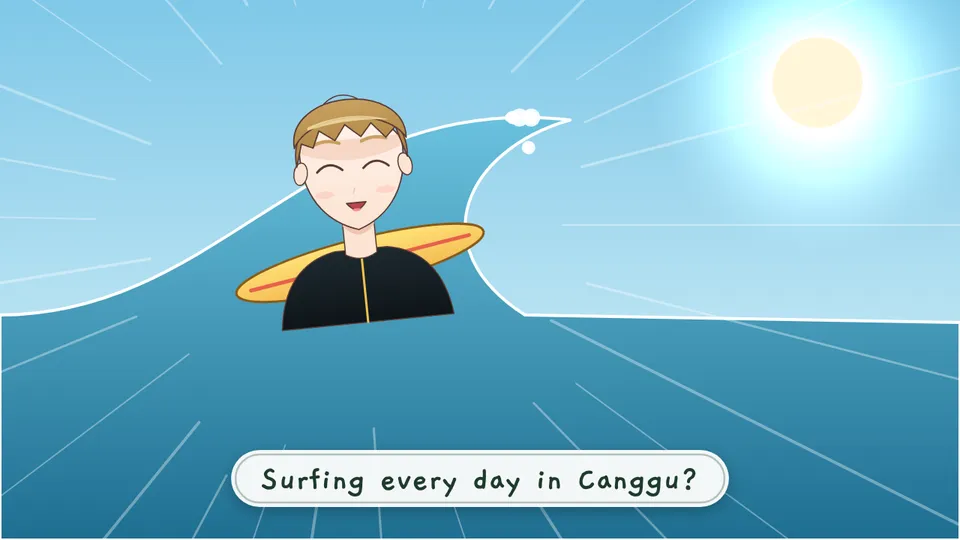
Bali's southwest coast is a surfer's playground. Beginners learn at Batu Bolong and Old Man's in Canggu, intermediates chase peaks at Echo Beach and Berawa, and Seminyak's beach breaks glow at sunset. Many surfers here are in the water once or twice a day, every day.
That's fantastic for the soul, and rough on the hair. "Surfer hair" might look effortlessly cool on Instagram, but up close it's often dry, crunchy, faded, tangled and breaking, with an itchy, salt-crusted scalp underneath.
Saltwater osmosis: why the ocean dries your hair
Seawater is roughly 3.5% salt. When your hair sits in a saltier environment than its own internal moisture, water moves out of the hair shaft to try to balance things out. That's osmosis. As the water evaporates in the sun, tiny salt crystals are left behind on your hair and scalp.
Osmosis in action
What happens in the line-upSalt draws water out of the hair shaft, then crystallises as it dries, leaving hair brittle and rough.
Tangles, friction and breakage
Salt is only part of the story. Every session hits your hair from several directions at once:
Salt crystals
Rough crystals lift and scrape the cuticle, so hair becomes coarse, dull and prone to splitting.
Wind and wipeouts
Offshore winds and tumbling in the white water whip wet hair into tight knots.
Sand
Fine sand gets trapped at the scalp, causing itching and acting like sandpaper on strands.
UV exposure
Hours on the water, with sunlight reflecting off it, break down keratin and fade colour. See our sun damage guide.
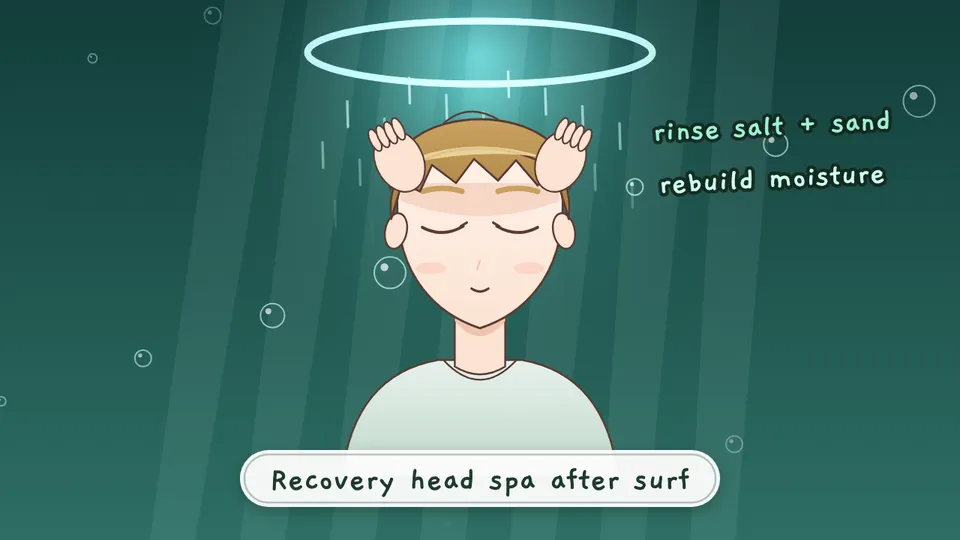
The surf recovery head spa
After days or weeks of surfing, regular shampoo just isn't enough to remove salt crystals and sand from the scalp. A Japanese head spa works as a deep reset:
- 1Assess
Scalp analysis
A magnified look at salt residue, sand, dryness and the condition of your strands.
- 2Clarify
Dissolve salt and sand
Micro-mist steam and deep cleansing dissolve crystals and wash trapped sand out of the follicles.
- 3Repair
Protein and moisture
Nourishing care replaces lost moisture and helps strengthen weakened strands.
- 4Soothe
Scalp massage and water halo
Shiatsu relieves neck and shoulder tension from paddling, and the water halo calms an itchy scalp.
Your neck and shoulders will thank you too. Hours of paddling with your head up builds serious tension at the base of the skull.
Pro surfer hair maintenance
Your surf-day hair routine
Choose a momentSoak your hair in fresh water so it absorbs less salt, smooth a little leave-in conditioner or light oil through the lengths, tie long hair in a loose braid and wear a surf cap in the midday sun.
Rinse with fresh water at the beach shower or with a bottle in your car within 15 minutes. Don't let salt dry on your scalp in the sun.
Use a sulfate-free shampoo on the scalp and conditioner on the ends. Detangle gently with a wide-tooth comb, starting from the ends.
Book a recovery head spa every 2–4 weeks to clear built-up salt, rebuild moisture and treat your neck to a well-earned release.
Keep a 1.5L bottle of fresh water in your car or on your scooter for an instant post-surf rinse. It's the simplest habit with the biggest payoff.
If you've had a reef cut or scrape on your scalp, let it heal fully before any scalp treatment, and seek medical care for any wound that looks infected.
Revive your hair post-surf
Keep chasing waves, and let us take care of the damage. Our head spa is in Seminyak, a short ride from Canggu's breaks and the beaches of Petitenget, Double Six and Legian. Living in Bali? Combine this with our guide to Bali's hard water and humidity.